Since its establishment by Johan Grobbelaar in 2000, "The Violin Connection of Southern Africa" has built a solid reputation as a specialist resource for both professional performers and students alike, not only supplying a broad range of instruments and bows, but also as a resource of knowledge and advice on general questions arising from the music world and music instruments.
This dealership regularly receives questions from musicians and the public about labels, origins, values and assessments of instruments. This page endeavours to answer some of the most common questions asked.
This page is subject to alterations, additions and general editing, to remain current and every effort is made to keep it so.
What follows are some of the most common questions.
Is it a Stradivarius?
This question also involves labels of Amati, Guarnerius, Maggini, Ruggieri, Bergonzi and many other high profile makers whose labels are routinely faked and put into cheap trade (factory) instruments.
I receive a constant stream of emails and phone calls from persons who have found an instrument with a Stradivarius label in it.
They always ask the same questions: Is it real? How can they tell if it is authentic? And the favorite - What’s it worth?
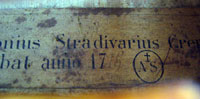
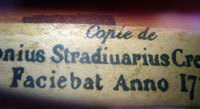
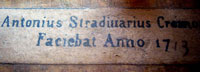
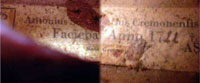
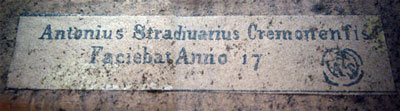
About 99.99 % of instruments with a Stradivarius label inside (or any such high-profile name) are “trade” (factory) instruments - they are produced in large studios or factories and are aimed at the student and amateur market. These labels simply mean that the instrument is based on the model of that maker. They do not claim that the instrument is his work and are sold with the understanding that it is not authentic.
Here are a few examples of such fake labels that people get excited about:
There are many such instruments in circulation with other versions of Stradivari’s labels. These instruments have nothing to do with Stradivari.
For more comments about this, you can also visit the Smithsonian Institute’s website below and read what they say about this practice: http://www.si.edu/Encyclopedia_SI/nmah/stradv.htm
back to top
About J. J. van de Geest
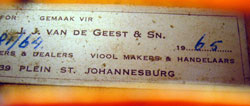
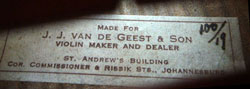
Apart from his own personal output as violinmaker, J. J. van de Geest imported “trade” (commercial instruments aimed at the student and amateur market) from mainly Germany, Holland and Japan. Such instruments were usually of reasonably good quality and he always labelled them as “Made for J J van de Geest”, followed by additional information, such as a serial number, date, address etc. These instruments were NOT made by J. J. van de Geest, but were the output of large trade studios (a euphemism for “factories”). Here are some examples of such labels:
 |
 |
These instruments (including a large number of violas, cellos and child instruments), emerge all over South Africa. I see many of them and have assisted people in selling them.
J J van de Geest’s personal output as violinmaker and his later contribution to the music life in South Africa is impressive: After completing his apprenticeship as violinmaker in Holland under the great master, Eberle, Jacobus Jan van de Geest (1899 – 1974) was for 18 years Master Craftsman and Chef d’atelier for London’s most important violin company – Hart & Son, under George Hart. Here he was in charge of assessments of and repairs to the world’s finest instruments. In London (and in fact in all of England and elsewhere) he established a reputation for supreme expertise and craftsmanship that stood him to credit for the rest of his life. When Hart & Son closed down in 1938, Van de Geest emigrated from London to Johannesburg, where he became the most important single force in South Africa’s violin world. He maintained his privileged relations with European experts and continued importing some of the finest violins available in Europe to his shop in Johannesburg. Many fabulous Cremonese and other instruments of great master violinmakers of the past made their way to South Africa through J J van de Geest’s work.
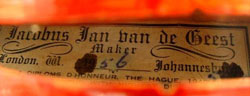
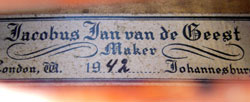
As violinmaker, J J van de Geest’s personal output was of the highest order conforming to the highest standards of the craft. In 1954 he won a gold medal in the Exposition of Liège. The great violinist and teacher, Carl Flesch, played on a Van de Geest and referred to him as “The Wonderful Dutchman”. Van de Geest produced a constant output of instruments by his own hand. These generally are labelled as “Made by Jacobus Jan van de Geest” followed by other details, the year, etc. Here are two examples of the labels of his own work:
 |
 |
back to top
Is my violin handmade?
Since all violins are handmade to more or lesser degree, including factory instruments, the question is rather, Is my violin a Trade (factory) violin or a fine violin?
This question is answered in detail in the page PRICE STRUCTURE under the sub-heading “About Trade and Fine Instruments”. See the menu bar above.
back to top
Do you give violin lessons?
No, not at this stage. I travel a lot and having violin students would mean giving them their lessons regularly every week.
back to top
Where can I find a suitable teacher?
Contact me directly and let me know where you live. I have a fairly comprehensive database and if I have information available, I will let you know who to contact.
back to top
How much should I pay for an instrument?
This question is answered to some extent in the page PRICE STRUCURES. (See the menu bar above…)
back to top
Can I rent a violin from you?
No, you can’t. At least not at this stage…
back to top
Can I pay off the violin over time?
See the page FOR BUYERS for a detailed answer.
back to top
Can I trade in my violin against another one?
No, you can’t. For a more complete answer see the page FOR BUYERS.
back to top
What is my violin worth?
This is answered in detail in the page PRICE STRUCURES.
back to top
Where can I have my instrument repaired?
I have comprehensive database of qualified, reputable and experienced violinmakers and craftsmen in different parts of South Africa who can do repairs to violins, violas, cellos and bows (and double basses) using the correct methods. If you need a repair done, please contact me directly by email and I will direct you to someone in your area who could carry such repairs.
Be aware that there are individuals throughout the country who routinely carry out work on stringed instruments, who by all standards are not qualified to do so, who do not use correct methods and who routinely damage instruments permanently, leaving them with virtually no resale value. I encounter their devastation on a regular basis, and often have the unfortunate task of telling the owners that their instruments have no further commercial value. Please go to the trouble to find a qualified craftsman!
(If you are qualified to carry out repairs to stringed instruments, and would like to be included in my database, please contact me directly.)
back to top
How much should I pay for repairs (& rehairs)?
As much as anyone in a free market system may charge whatever he likes for his services, the reality is that there are norms within the violin world that most reputable repairmen adhere to. Unfortunately some individuals have exploited their clients' ignorance about repairs and the normal associated costs, and are simply ripping them off.
In the mean time, if you have doubts about the fairness or validity of a quote, please contact me and will advise as best I can.
back to top
About SANYO
SANYO is the South African National Youth Orchestra.
Here are their details:
www.sanyo.org.za
back to top